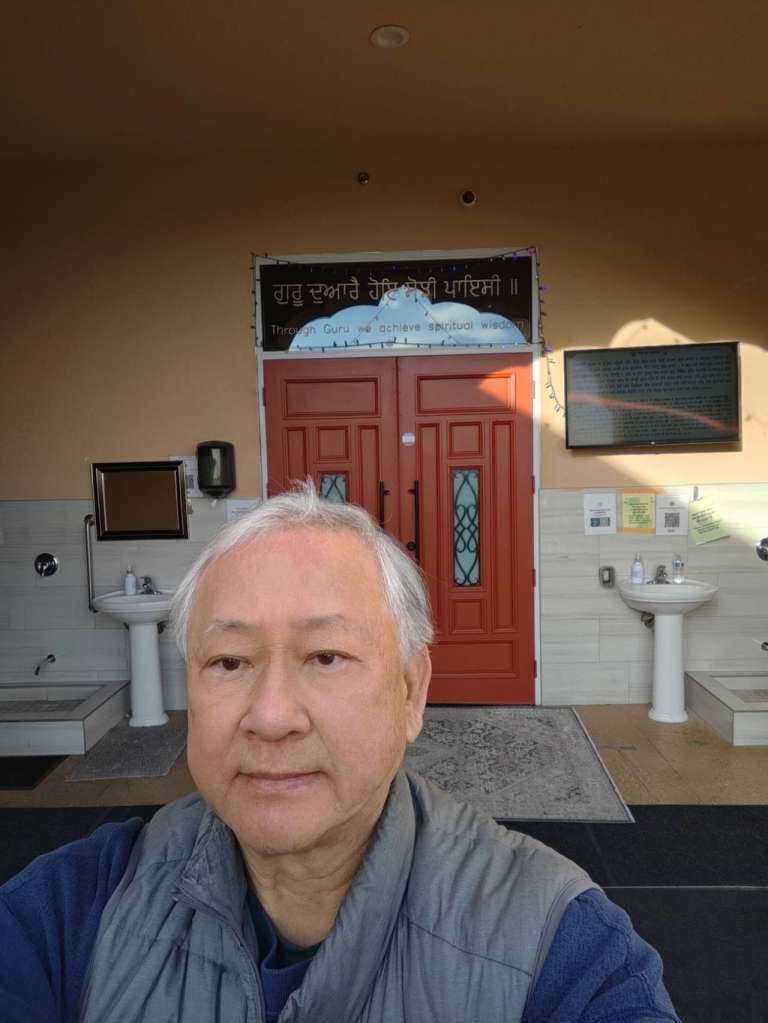
Sikhism in Enterprise, South Las Vegas – February, 2025
My first encounter with Sikhism was a wonderful experience. Mehnga Singh, the High Priest showed me how to tie a head scarf and clean hands and feet before entering the worship hall. We shared view of peace and harmony for all people and faiths in this chaotic world. He served me with a sweet indigenous pastry before I left..







What’s the difference between Sikhism and Hinduism?
The differences between Sikhism and Hinduism are significant, rooted in distinct histories, beliefs, practices, and social structures. Here’s a detailed comparison:
1. Origin and Historical Context
- Sikhism:
- Founded in the 15th century in Punjab (South Asia) by Guru Nanak Dev Ji, the first of the Ten Sikh Gurus.
- Emerged as a reform movement emphasizing equality, devotion to one God, and rejection of ritualism and caste.
- Hinduism:
- An ancient, diverse religion with roots dating back over 4,000 years in the Indian subcontinent.
- No single founder; evolved through Vedic traditions, Upanishadic philosophy, and regional practices.
2. Core Beliefs
- Sikhism:
- Strict monotheism: Belief in One Formless God (Ik Onkar), beyond gender or physical form.
- Rejects idol worship, rituals, and caste hierarchy.
- Emphasizes equality (all humans are equal), selfless service (seva), and truthful living.
- Goal: Merge with God through devotion, honest work, and remembrance (Nam Simran).
- Hinduism:
- Diverse beliefs, ranging from monotheism (e.g., Vaishnavism) to polytheism (worship of many deities) and pantheism (God in everything).
- Central concepts include dharma (duty), karma (action and consequence), samsara (cycle of rebirth), and moksha (liberation).
- Accepts caste system (though debated in modern times) and ritual practices.
3. Deities and Worship
- Sikhism:
- Worship focuses on the Guru Granth Sahib (Sikh scripture) as the eternal Guru.
- No idols or images of God; worship occurs in gurdwaras (temples with communal kitchens, langar).
- Key figures: The Ten Gurus and martyrs like Guru Tegh Bahadur.
- Hinduism:
- Worships a vast pantheon of deities (e.g., Vishnu, Shiva, Devi, Ganesha).
- Rituals (puja), offerings, and temple worship are common.
- Reverence for sacred texts (Vedas, Bhagavad Gita) and avatars (e.g., Krishna, Rama).
4. Scriptures
- Sikhism:
- Guru Granth Sahib: The central holy text, compiled by Sikh Gurus. Contains hymns and teachings of Sikh Gurus and saints from other faiths.
- Dasam Granth: A secondary text with writings by Guru Gobind Singh.
- Hinduism:
- Vedas, Upanishads, Puranas, Bhagavad Gita, and epics like the Mahabharata and Ramayana.
- Diverse regional texts and traditions.
5. Social and Ethical Practices
- Sikhism:
- Equality: Rejects caste, gender discrimination, and social hierarchies.
- Five Ks: Articles of faith (uncut hair, comb, steel bracelet, dagger, and shorts).
- Langar: Free communal meal for all, regardless of background.
- Hinduism:
- Traditionally structured around the caste system (though modern reforms challenge this).
- Practices vary widely: vegetarianism, fasting, pilgrimage, yoga, and meditation.
6. Afterlife and Salvation
- Sikhism:
- Focus on ending the cycle of rebirth by merging with God through devotion and righteous living.
- Rejects asceticism; emphasizes living as a householder.
- Hinduism:
- Liberation (moksha) from samsara through knowledge, devotion, or action.
- Belief in reincarnation based on karma.
7. Symbols and Identity
- Sikhism:
- Khanda (double-edged sword) and Ik Onkar (symbol of one God).
- Visible identity: Turban (dastar) and the Five Ks.
- Hinduism:
- Symbols like Om, Swastika, and deities’ icons.
- Diverse cultural practices across regions (e.g., bindi, sacred thread).
Key Similarities
- Both emphasize ethical living and devotion to a higher power.
- Share cultural and geographical roots in South Asia.
- Revere saints and teachers (e.g., Sikhism includes hymns from Hindu and Muslim saints in the Guru Granth Sahib).
Summary
Sikhism is a distinct monotheistic faith rejecting caste, idol worship, and ritualism, while Hinduism is a diverse, ancient tradition with varied beliefs and practices. Sikhism’s emphasis on equality, community service, and devotion to one God sets it apart, despite shared cultural contexts with Hinduism.

 OHM
OHM 